
The Divine Clothing Principle
In Scripture, clothing is never just fabric; it is identity, authority, and covenant token. From Solomon’s servants to Christ’s seamless robe, God reveals a deeper truth: the Kingdom clothes its own. What rests upon you in the spirit shapes how you are perceived in the natural.
There is a mystery woven through Scripture (subtle, yet persistent) that the sons and daughters of God are known not merely by confession, but by appearance. Not the kind defined by fabric or fashion, but the kind that emanates from identity, consecration, and spiritual posture.
When the Queen of Sheba came to Solomon, what overwhelmed her was not first the gold, the architecture, or even the opulence of the palace. Scripture tells us she was struck by something deeper: the appearance of his servants, the apparel of his ministers, the bearing of those who stood before him. She saw something peculiar; a distinction that could not be bought, copied, or fabricated. And the record says there was no more spirit in her.
If the servants of an earthly king could carry such radiance, what then should be said of those who belong to the King of kings?
Jesus makes a profound comparison when He says that even Solomon in all his glory was not arrayed like one of the lilies of the field. Why would He say this? Because Solomon’s garments, though royal, were external. They could adorn, but they could not sustain life. They could impress, but they could not regenerate. The beauty of the lily, however, is God-imparted. It is effortless, sustained from within and renewed by divine law rather than human effort.
Because to be God’s own is to wear an appearance that heaven endorses and earth cannot fully interpret.
In Scripture, garments are never passive. They symbolize favor, authority, priesthood, restoration, righteousness, and salvation. Esther’s royal apparel gave her access before the king. Joseph’s change of garments signaled his authority in Egypt. The prodigal son was restored with a robe before his position was restored in the house. Isaiah declares that we are clothed with garments of salvation and covered with robes of righteousness. Simply put, what you are clothed with attracts what comes to you.
This is why, throughout Scripture, God often clothes a person spiritually before He elevates them naturally. Joseph received a coat before he received a throne. Priests were robed before they ministered. At the crucifixion, Jesus wore a seamless garment, woven from top to bottom; priestly in nature and unique enough that even hardened soldiers refused to tear it. That garment was not about style; it was about marking, an imprint and a visible testimony of divine origin.
There is something about belonging to God that produces a peculiar appearance that is first spiritual before it is material.
When a life is yielded to God, something shifts in the bearing of that person. There is refinement and dignity, like a halo that rests upon them from a sense of covenant standing. People may not have language for it, but they perceive it. Rooms respond to it. Opportunities gravitate toward it. Even resistance recognizes it.
When Jesus said, “You are the light of the world,” He was not speaking metaphorically alone. Light is a form of appearance. Light announces presence. It attracts, reveals and marks an individuals’ true nature. To carry God is to carry illumination that cannot hide itself. You cannot wear light and consistently attract darkness. You cannot wear glory and attract shame. You cannot wear righteousness and attract disgrace. Your clothing speaks. It summons. It reveals your kingdom.
What does this mean for you?
It means your appearance in the spirit is doing more than you think. It means God is more invested in how your spirit is clothed than your wardrobe. It also means when God clothes you, nothing can truly strip you. The blessing does not merely visit you , but like a garment, it rests upon you. You may not always feel extraordinary, but the garments of God on a yielded life are never ordinary. They are the reason doors open. The reason favor finds you. The reason certain things are drawn toward you and others are repelled.
Considering you are not merely dressed spiritually, what rests upon you in the spirit almost always finds expression in the physical. John the Baptist, clothed in camel’s hair and leather, embodied the austerity and consecration of his calling. In the same way, a regenerated believer often finds themselves drawn toward a certain manner of dress, tone, or presentation — not out of imitation, but out of alignment. There is often a natural gravitation toward colors, textures, and styles that reflect the inward posture of the spirit. Scripture itself acknowledges that attire carries meaning. There were garments specific to men and to women, the attire of a harlot, the clothes of widowhood, grave clothes, wedding garments, priestly robes, garments of skin, and fabrics set apart for sacred use. Clothing, in biblical language, was never random; it communicated identity, season, covenant, and calling.
So let’s take the time to consider: What have you been wearing in the spirit? Is your life clothed in anxiety or in alignment? In striving or in surrender? In image or in identity? When people encounter you, what rests upon you?
Let us Pray:
“Father, Clothe me in what cannot fade. Strip from me every garment not issued by You — every covering of pride, fear, comparison, or striving. Robe me in righteousness. Wrap me in humility. Let the light of Your countenance rest upon my life in a way that cannot be manufactured or imitated. Adorn my spirit as You elevate my platform. Let what rests upon me speak before I speak. And may my life reflect the glory of the One who clothes the lilies and calls me His own. Amen.”
The life of a re-generated believer is one called out of conformity unto distinction. Even in our appearance, there is a peculiar appearance that accompanies a yielded life and it cannot be curated or performed. What clothes you in the spirit will inevitably express itself in your life, choose Light.
Identity: The Anchor of the Soul
True identity is not self-created; it is discovered through revelation. Formed in delight, refined in separation, and proven in action, identity becomes the anchor of the soul. But no man can fully know himself without first exploring who God is.
As a writer, identity can be customized. A character may evolve, unravel, or be reshaped depending on the direction of the story. In fiction, identity bends to narrative intention. It can be rewritten, redirected, or redeemed in a matter of pages. But in real life — like when we are doing the sacred work of the soul — identity cannot be improvised. For any meaningful transformation to take place, for any true progress to be recorded, one must be rooted in true identity. Identity may mature. It may deepen. It may expand along the spectrum of convictions a man exposes himself to and embraces. But it must have a root. Without a root, growth becomes drift. Without foundation, movement becomes wandering.
So what, then, is the first step toward self-actualization?
Everything begins with desire.
Not every desire qualifies, however. The desire that births identity is not carnally manufactured. It is not born of comparison, insecurity, or ambition. It is birthed in delight. As it is written, “Delight yourself in the Lord, and He will give you the desires of your heart.” When a man delights in God, something profound happens within him. His longings are refined. His appetites are aligned. What once felt impulsive becomes intentional. Desire becomes revelation. In delight, Heaven plants vision. True identity begins when desire is shaped by divine affection.
Once desire is conceived, it demands response. A man must separate himself and immerse himself in the wisdom associated with what has been stirred in his heart. Desire without discipline becomes fantasy. Separation does not mean abandoning people; it means guarding focus. It means withdrawing from noise in order to pursue formation. It means intermeddling deeply with the truths, practices, and understanding connected to what you want. If you desire leadership, you must study leadership. If you desire holiness, you must pursue holiness. If you desire purpose, you must seek understanding. Identity is forged in intentional pursuit. In quiet places of study, prayer, discipline, and reflection, your convictions begin to take shape. What was once a faint stirring becomes clarity.
And clarity demands embodiment.
In the place of wisdom exploration, convictions are forged, and belief begins to translate into action. You begin to prioritize differently. You begin to move differently. The proof that you know is that you do. Identity is not validated by declaration; it is established by embodiment. When your actions align with your convictions, your identity becomes anchored. Self-actualization shifts from aspiration to alignment.
Identity, then, becomes the anchor of a man’s soul. It is only when a man knows who he is, accepts his nature, receives the vision of his future, and aligns his priorities to walk in that path that he can steward his life with clarity and authority. Stability is not the absence of storms; it is the presence of anchoring.
Yet even here, we must confront a deeper truth. Man cannot fully know himself without first exploring who God is. Modern culture urges us to find ourselves, but identity does not begin with self-examination alone. It begins with revelation.
Scripture teaches that we behold as in a glass the image of the Lord and are transformed into that same image. The mirror matters. What you consistently behold will inevitably shape you. If you gaze long enough into the wrong reflection, you will slowly become a distortion of your design. But when you behold Him, something remarkable happens — you begin to recognize yourself.
The tragedy is not that a man never looked. It is that he looked and forgot.
James speaks of the one who looks into a mirror and immediately forgets what he saw. Identity requires remembrance. It requires staying true to what was revealed. It requires refusing to become a forgetful hearer who walks away unchanged. When you behold God, you are shown not only who He is but who you were created to be. Staying anchored means staying aligned with that image, even when circumstances attempt to redefine you.
So let’s pause for a moment. What have you been beholding lately? What desires have been forming in your heart, and where were they born? Are your current actions aligned with your declared convictions? Identity is not found in haste. It is formed in delight, refined in separation, and proven in action. Perhaps the real question is not simply, “Who am I?” but “Whom am I beholding?” Because in that mirror lies your becoming.
Let us pray:
“Father, I desire to know You, not in passing, but in truth. As I behold You as in a glass, reveal to me the image You have ordained for my life. Guard me from becoming a forgetful hearer who walks away from revelation unchanged. Shape my desires as I delight in You. Form my convictions through wisdom. Anchor my soul in identity that cannot be shaken. Teach me who You are, that I may truly understand who I am. Amen.”
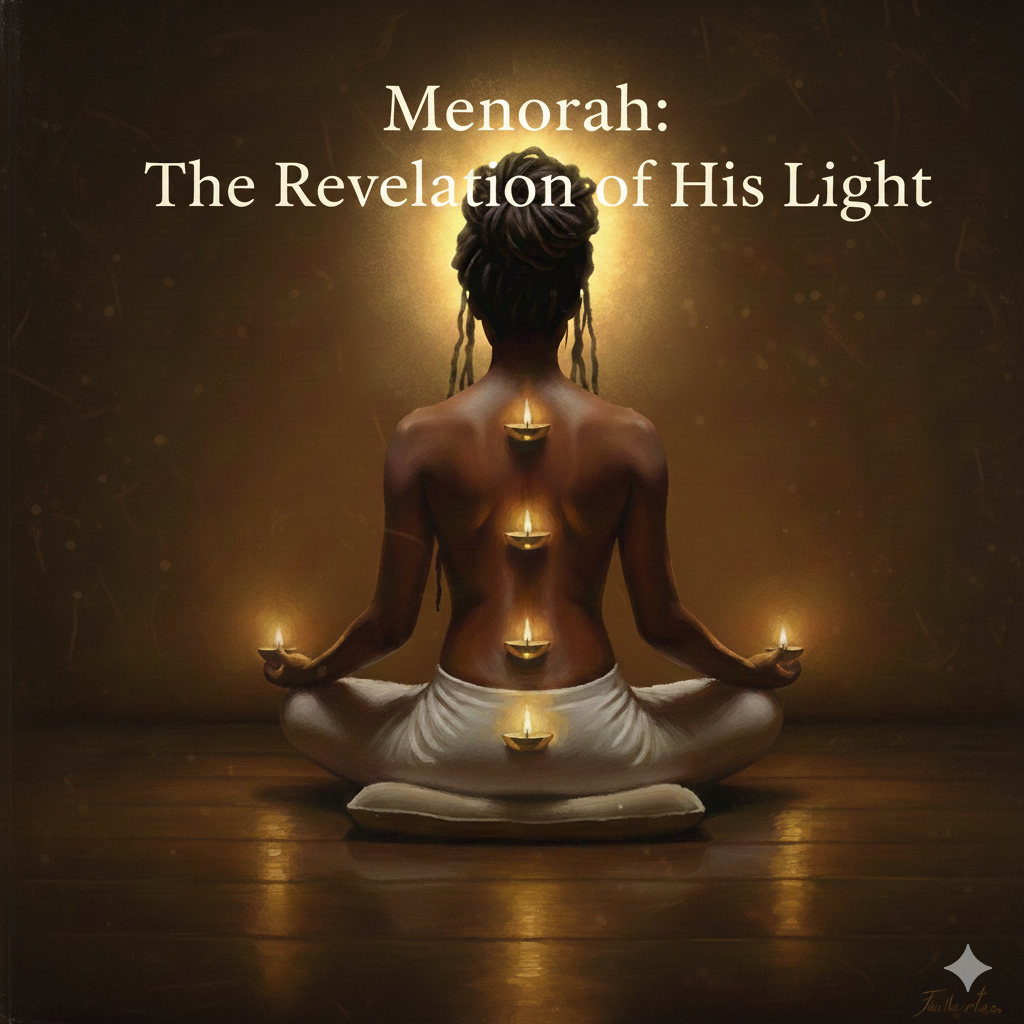
Menorah: The Revelation of His Light
In the Holy of Holies, there was no lamp, only the Presence. This meditation explores how the believer becomes God’s inner lampstand, lighting the Menorah within until illumination rises from the inside out.
When I was younger, darkness terrified me. It felt like a gruesome weight of a presence pressing in from all sides. With the lights on, everything feels lighter; shadows lost their teeth, and the world became gentle again. Those were the days of imagining monsters in corners and demons beneath the bed. Any sliver of light felt like safety.
But as I grew older, my understanding shifted. I began to train my consciousness, unlearning the illusions of childhood. I learned that the “monsters” were not real per se, and the demons held no power over a child of light. Slowly, the weight of darkness lifted. Now it was not because the room changed, but because I changed. I discovered I was a city set upon a hill, a very bright lamp that could not be hidden. I discovered that I am a bearer of divine radiance.
The irony is that the brighter my inner world became, the more I found peace in the very darkness that once tormented me. I began to love dim rooms, with little or no lights and minimal distractions, just enjoying the stillness. I could sit for hours, losing sense of time, finding a solitude that ministered to me in ways noise never could. My deepest prayers formed there, my thoughts became clearer; in here I had my truest encounters.
It was during these moments that I was drawn into a meditation on the tabernacle of Moses. This, as we know from scriptures (Exodus 25-31), is the first physical representation of the temple of God. It was delivered expressly to Moses on the mount and God commanded that it was built according to that pattern (Exodus 25:9,40. Hebrews 8:5). In that temple, the people approached God from a distance. Only the high priest entered beyond the veil, carrying sacrifices for himself and the nation. Now, beyond the veil, in that structured separation, something profound was revealed.
While the Outer Court lived in natural sunlight, and the Holy Place was lit by the golden lampstand, the Menorah, the Holy of Holies remained without any man-made source of light. Behind that thick veil, no flame burned, no lamp flickered. The only illumination came from the very Presence of God: the Glory, the Kavod. It was this divine overshadowing of the Mercy Seat that filled the room with light.
And suddenly Scripture aligned itself in me:
“The Lord shall be a light unto her, and there shall be no night there.” (Revelation 21:23-25)
The more I sat in the darkness, the more I understood why I felt so at home. I was not sitting in the dark. I was sitting in Him. I had encountered the Father of Lights, and in His presence, darkness loses definition. It does not register the same way because everything is lit from within. This led me into a meditation practice I can only describe as self-illumination; not in the mystical or self-exalting sense, but in the deeply scriptural reality that Christ in me is the Light of the world. In these moments, I sit quietly, aware of my body as a vessel of glory, beholding the word of God in Isaiah 11:2, until the candles of the Lord are lit within me.
Recall, before the priest stepped into the Holy of Holies, he first tended the lampstand in the Holy Place. In the same way, I begin by lighting the Menorah within by meditating on the sevenfold Spirit of God, recognizing in sequence the operations of the Spirit at work in me, furnished by the understanding that the spirit of man is the candle of the Lord, searching the inward parts (Proverbs 20:27). And as I behold Him in Isaiah 11:2, one light at a time- wisdom, understanding, counsel, might, knowledge, and the fear of the Lord- the consciousness begins to rise. A quiet kindling, like a warm inner brightness. An illumination that does not come from the room around me, but from the Presence within me until the space is lit from the inside out.
And this is what I long for you to discover too.
There is so much in God that we often rush past; there are treasures of revelation waiting to be explored, if only we would sit long enough to behold them. For me, it began with a simple encounter: “You are the light of the world.” I lingered over that scripture until it enlightened me from within, until I could trace its glow into every corner of my life.
What word has touched your heart recently?
Have you sat with it long enough for it to transform you? Have you allowed the Spirit to paint its reality on the canvas of your imagination, through quiet, focused meditation? Because when the seven candles are lit within you, the presence of God becomes almost tangible. It is from this inner illumination that the soul moves, gently and naturally, toward the Holy of Holies within.
And just as the High Priest carried the Urim and Thummim beneath the breastplate, close to his heart, so we too carry the revelation of righteousness as a living, awakened conscience under Christ. In that place of holy stillness, where light and truth converge, the whole counsel of God becomes available. Suddenly, you are not groping in the dark for answers; you are standing in light, equipped with divine insight for every matter presented before you.