

Iron Sharpens Iron
There are spaces you leave sharper, clearer, more aligned with yourself—and there are others where something in you feels quietly diminished. Scripture says iron sharpens iron, but that truth carries a deeper question: are you being refined, or are you slowly losing your edge? Because not every connection is designed to make you better.
There is a kind of transformation that only happens in proximity. Not in isolation, not in admiration from afar, but in the quiet, consistent rubbing of lives, thoughts, convictions, and spirit. Scripture says, “Iron sharpeneth iron; so a man sharpeneth the countenance of his friend.” But that statement carries an assumption we often overlook—that both parties are iron. Because not everything sharpens. Some things wear down. Some distort. Some quietly damage what once held edge and precision.
Ecclesiastes tells us that “a man’s wisdom maketh his face to shine.” There is a kind of company that brightens you, not just emotionally, but mentally, spiritually, even visibly. And yet, not all association produces this effect. The quality of what you are surrounded by determines what is drawn out of you. Scripture also says that the counsel in the heart of a man is like deep waters, but a man of understanding will draw it out. That means true relationships are not shallow exchanges; they are spaces of excavation, where depth meets depth and something refined emerges.
But not everyone carries that kind of substance. In a great house, Scripture says, there are vessels of gold and silver, but also of wood and earth. We may all exist within the same house, the same environment, even the same faith community, but we are not all of the same composition. Some are wood—easily shaped, but also easily consumed. Some are stone—rigid, resistant, unyielding. And some are iron—formed through pressure, able to withstand friction, capable of both impact and refinement. The issue is not the existence of these materials; the issue is the assumption that proximity equals alignment.
When iron is sharpened by iron, there is precision. But when iron is constantly rubbed against stone, it begins to chip, to distort, to lose form. When it leans too long on wood, it becomes dull, softened by what cannot challenge it. And this is how many lose their edge—not suddenly, but gradually, through constant exposure to the wrong kind of friction.
This is why Scripture is intentional about company. “He that walketh with wise men shall be wise: but a companion of fools shall be destroyed.” You do not stay the same; you become. Company is not neutral; it is formative. It shapes your thoughts, your convictions, your responses, your identity. It is why we are warned not to walk in the counsel of the ungodly, and also encouraged not to neglect the gathering of the brethren. Because where you sit, who you listen to, and what you absorb are all quietly sharpening or dulling your life.
This truth becomes even more delicate in close relationships. In friendships, in partnerships, and especially in marriage, there is constant contact. You are not simply existing beside each other; you are refining each other, whether intentionally or not. Scripture instructs us to dwell with understanding, because alignment is not automatic. It is cultivated. There must be shared exposure, shared growth, shared substance. When two people are not feeding from the same source, their friction does not refine; it frustrates. But when there is alignment in Word, in Spirit, and in pursuit, something beautiful begins to happen. Each interaction produces clarity, sharpens perspective and becomes a point of refinement.
And then there is the highest form of sharpening—God Himself. Because what is iron before the One who formed it? When we engage with God, it is no longer friction as we know it; it is transformation. The same Scripture that says he who walks with the wise will be wise points us to a greater reality—what happens when you walk with Wisdom personified. Scripture records that as the disciples went forth, the Lord worked with them, confirming their words with signs following. This is what happens when alignment meets obedience. God does not dull you, rather He refines you into accuracy.
So it is worth asking, quietly and honestly: who sharpens me? Where do I leave clearer than I arrived? Who challenges me without corrupting me? Who carries what I desire to grow into? And also, where am I becoming dull? Where is my edge being compromised, slowly and subtly, through the company I keep?
Because the truth is, we are not all fully formed. There are still areas of us that are stone; rigid, resistant, unyielding. But Scripture gives us hope: “I will take away the stony heart out of your flesh, and I will give you an heart of flesh.” Only God can do that. Only He can reshape substance and turn what resists into what responds. And this is the end of it all—not just that we are sharpened, but that we are transformed. That we become people of the Word. Scripture says the Word of God is living and powerful, sharper than any two-edged sword. That is the goal; not just to be sharpened, but to become sharp. To become precise, discerning and aligned.
Let’s Pray: “Lord, align me with the right company. Give me the discernment to know what sharpens me and what dulls me. Refine my heart, remove every stony place, and make me responsive to Your Word. Let my life be shaped by truth, and let every connection I keep draw me closer to who You have called me to be. In Jesus’ name, Amen.
Remember, not every space is for you. Not every voice is for you. Not every connection is assigned to refine you. Some are distractions. Some are tests. But there are those rare, God-aligned relationships where you leave sharper, clearer, and more grounded in truth.
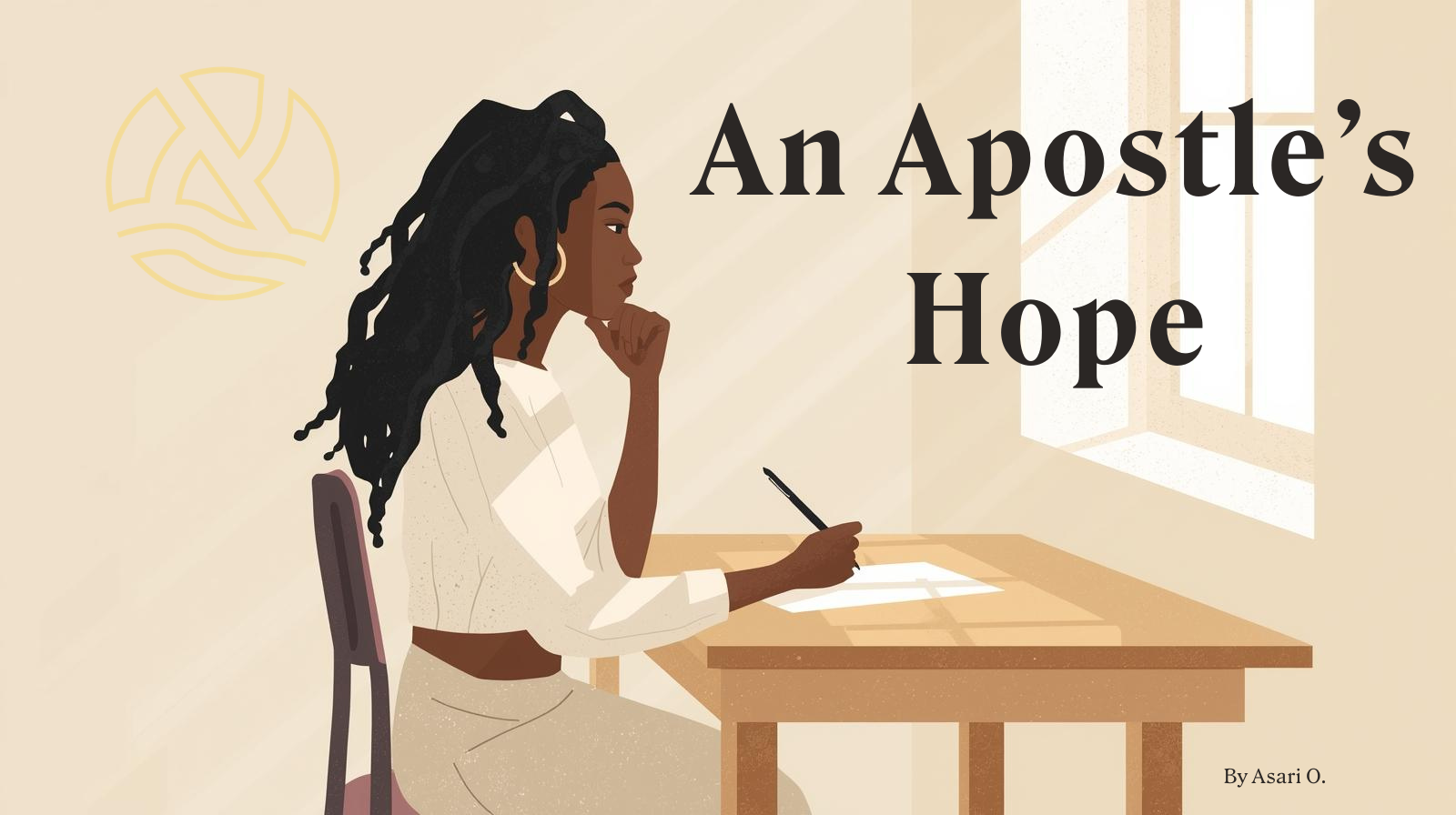
An Apostle’s Hope
An Apostle’s Hope is the prayer that we learn to interpret the subtle impressions of the Spirit with accuracy. For life unfolds in seasons, and discernment determines whether we misread them or steward them well.
It is the sincere prayer of an Apostle that we are able to accurately interpret the impressions of the supernatural as we journey through life. Not merely to experience them, not merely to sense them but to discern them rightly. For there are moments when heaven brushes against time, when eternity leans into the ordinary rhythm of our days, and something within us stirs. An impression. A knowing. A weight. A nudge.
But the difference between stagnation and progress is not the presence of impressions. It is the accuracy of interpretation.
Life unfolds in seasons, and seasons are not always announced with clarity. They are often whispered. The ability to discern them—to recognize when a door has opened, when a grace has shifted, when a chapter is closing—makes all the difference. A man may pray for advancement yet fail to recognize the season of preparation. A woman may long for elevation yet resist the pruning that precedes it. Without discernment, we mislabel our moments. Without alignment, we fight the very process meant to form us.
And yet, even as we move through these seasons, we must remain connected to the eternal whole. We are not wanderers responding to random impulses; we are sons and daughters responding to divine rhythm. There is an overarching counsel of God that frames our lives, and within it are smaller, shifting movements, like divine cues embedded within time.
It is the responsibility of man to take the required action birthed at the climax of the knowledge he is brought into. Revelation is not ornamental. Insight is not decorative. When light comes, it demands response. The weight of understanding carries with it the obligation of obedience. To know and not act is to interrupt the rhythm of alignment.
There are moments when clarity reaches its peak, when what was once impression becomes conviction. In that moment, action becomes the bridge between revelation and manifestation. Heaven may impress on us, but the responsibility lies with us to respond.
Through conscious meditation and intentional stillness, we learn to stay on the frequency of our internal rhythm, which is the rhythm of the Spirit bearing witness within us. This is not mysticism detached from reality; it is attentiveness anchored in truth. When we cultivate inner awareness through prayer, reflection, and obedience, we sharpen our ability to recognize divine signals.
To stay on that frequency is to live attuned. It is to move through life not merely reacting, but discerning. Not merely surviving, but interpreting. And in doing so, we maximize our seasons. We cease resisting necessary transitions. We stop clinging to expired graces. We embrace new instructions without fear. We become effective witnesses not only of doctrine, but of lived reality in God.
Let us pray:
“Father, help me interpret the impressions You place upon my heart with clarity and accuracy. Guard me from misreading my season or resisting necessary movement. When knowledge reaches its fullness in me, give me the courage to act. Keep my spirit attuned to Your rhythm, and let my life reflect faithful alignment with what You reveal. In Jesus’ name, Amen.”
The goal is not simply to sense the supernatural. The goal is to interpret it accurately, respond faithfully, and embody it fully. For in that alignment, we do not merely pass through seasons but to steward them.
The Divine Clothing Principle
In Scripture, clothing is never just fabric; it is identity, authority, and covenant token. From Solomon’s servants to Christ’s seamless robe, God reveals a deeper truth: the Kingdom clothes its own. What rests upon you in the spirit shapes how you are perceived in the natural.
There is a mystery woven through Scripture (subtle, yet persistent) that the sons and daughters of God are known not merely by confession, but by appearance. Not the kind defined by fabric or fashion, but the kind that emanates from identity, consecration, and spiritual posture.
When the Queen of Sheba came to Solomon, what overwhelmed her was not first the gold, the architecture, or even the opulence of the palace. Scripture tells us she was struck by something deeper: the appearance of his servants, the apparel of his ministers, the bearing of those who stood before him. She saw something peculiar; a distinction that could not be bought, copied, or fabricated. And the record says there was no more spirit in her.
If the servants of an earthly king could carry such radiance, what then should be said of those who belong to the King of kings?
Jesus makes a profound comparison when He says that even Solomon in all his glory was not arrayed like one of the lilies of the field. Why would He say this? Because Solomon’s garments, though royal, were external. They could adorn, but they could not sustain life. They could impress, but they could not regenerate. The beauty of the lily, however, is God-imparted. It is effortless, sustained from within and renewed by divine law rather than human effort.
Because to be God’s own is to wear an appearance that heaven endorses and earth cannot fully interpret.
In Scripture, garments are never passive. They symbolize favor, authority, priesthood, restoration, righteousness, and salvation. Esther’s royal apparel gave her access before the king. Joseph’s change of garments signaled his authority in Egypt. The prodigal son was restored with a robe before his position was restored in the house. Isaiah declares that we are clothed with garments of salvation and covered with robes of righteousness. Simply put, what you are clothed with attracts what comes to you.
This is why, throughout Scripture, God often clothes a person spiritually before He elevates them naturally. Joseph received a coat before he received a throne. Priests were robed before they ministered. At the crucifixion, Jesus wore a seamless garment, woven from top to bottom; priestly in nature and unique enough that even hardened soldiers refused to tear it. That garment was not about style; it was about marking, an imprint and a visible testimony of divine origin.
There is something about belonging to God that produces a peculiar appearance that is first spiritual before it is material.
When a life is yielded to God, something shifts in the bearing of that person. There is refinement and dignity, like a halo that rests upon them from a sense of covenant standing. People may not have language for it, but they perceive it. Rooms respond to it. Opportunities gravitate toward it. Even resistance recognizes it.
When Jesus said, “You are the light of the world,” He was not speaking metaphorically alone. Light is a form of appearance. Light announces presence. It attracts, reveals and marks an individuals’ true nature. To carry God is to carry illumination that cannot hide itself. You cannot wear light and consistently attract darkness. You cannot wear glory and attract shame. You cannot wear righteousness and attract disgrace. Your clothing speaks. It summons. It reveals your kingdom.
What does this mean for you?
It means your appearance in the spirit is doing more than you think. It means God is more invested in how your spirit is clothed than your wardrobe. It also means when God clothes you, nothing can truly strip you. The blessing does not merely visit you , but like a garment, it rests upon you. You may not always feel extraordinary, but the garments of God on a yielded life are never ordinary. They are the reason doors open. The reason favor finds you. The reason certain things are drawn toward you and others are repelled.
Considering you are not merely dressed spiritually, what rests upon you in the spirit almost always finds expression in the physical. John the Baptist, clothed in camel’s hair and leather, embodied the austerity and consecration of his calling. In the same way, a regenerated believer often finds themselves drawn toward a certain manner of dress, tone, or presentation — not out of imitation, but out of alignment. There is often a natural gravitation toward colors, textures, and styles that reflect the inward posture of the spirit. Scripture itself acknowledges that attire carries meaning. There were garments specific to men and to women, the attire of a harlot, the clothes of widowhood, grave clothes, wedding garments, priestly robes, garments of skin, and fabrics set apart for sacred use. Clothing, in biblical language, was never random; it communicated identity, season, covenant, and calling.
So let’s take the time to consider: What have you been wearing in the spirit? Is your life clothed in anxiety or in alignment? In striving or in surrender? In image or in identity? When people encounter you, what rests upon you?
Let us Pray:
“Father, Clothe me in what cannot fade. Strip from me every garment not issued by You — every covering of pride, fear, comparison, or striving. Robe me in righteousness. Wrap me in humility. Let the light of Your countenance rest upon my life in a way that cannot be manufactured or imitated. Adorn my spirit as You elevate my platform. Let what rests upon me speak before I speak. And may my life reflect the glory of the One who clothes the lilies and calls me His own. Amen.”
The life of a re-generated believer is one called out of conformity unto distinction. Even in our appearance, there is a peculiar appearance that accompanies a yielded life and it cannot be curated or performed. What clothes you in the spirit will inevitably express itself in your life, choose Light.
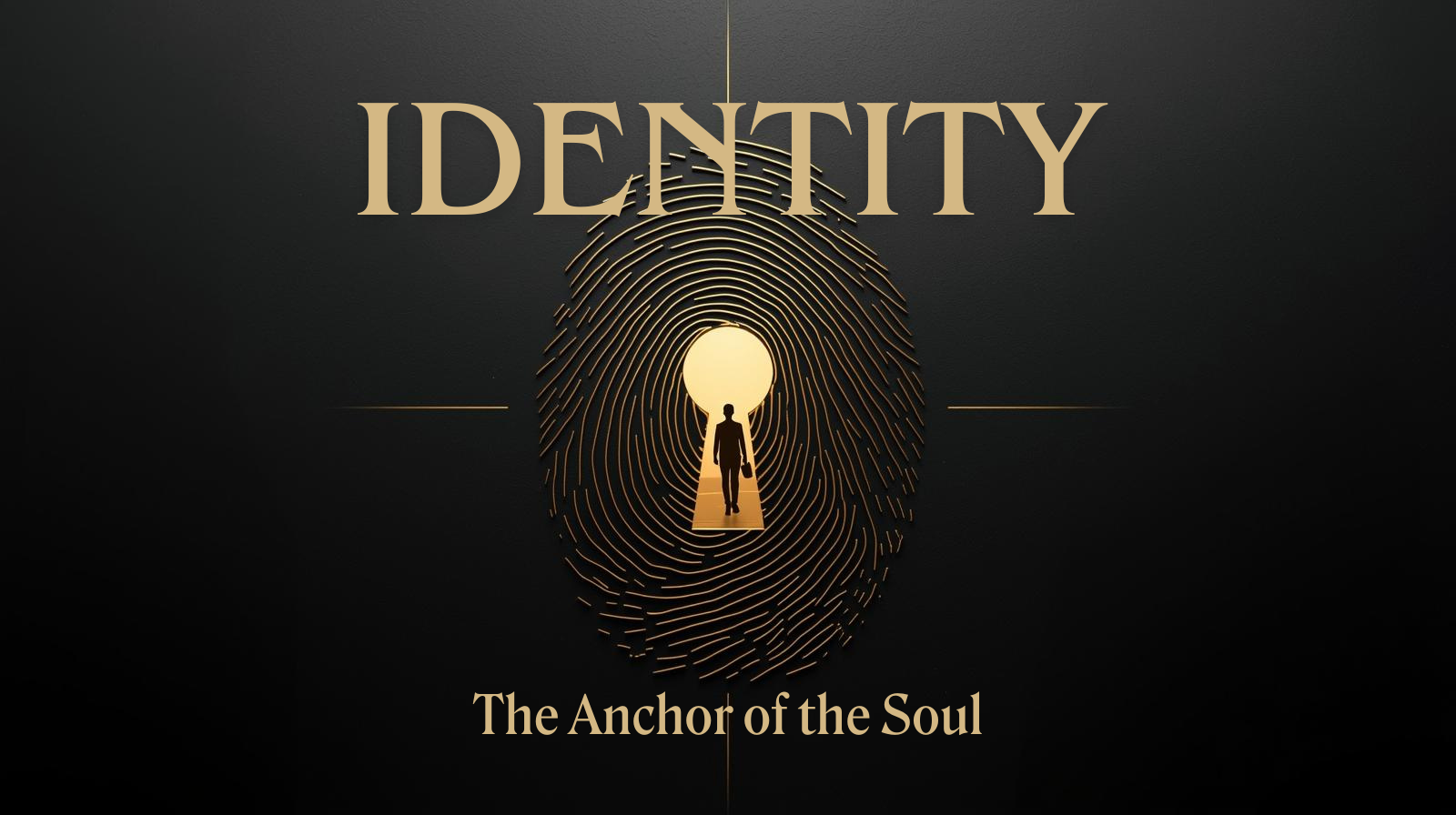
Identity: The Anchor of the Soul
True identity is not self-created; it is discovered through revelation. Formed in delight, refined in separation, and proven in action, identity becomes the anchor of the soul. But no man can fully know himself without first exploring who God is.
As a writer, identity can be customized. A character may evolve, unravel, or be reshaped depending on the direction of the story. In fiction, identity bends to narrative intention. It can be rewritten, redirected, or redeemed in a matter of pages. But in real life — like when we are doing the sacred work of the soul — identity cannot be improvised. For any meaningful transformation to take place, for any true progress to be recorded, one must be rooted in true identity. Identity may mature. It may deepen. It may expand along the spectrum of convictions a man exposes himself to and embraces. But it must have a root. Without a root, growth becomes drift. Without foundation, movement becomes wandering.
So what, then, is the first step toward self-actualization?
Everything begins with desire.
Not every desire qualifies, however. The desire that births identity is not carnally manufactured. It is not born of comparison, insecurity, or ambition. It is birthed in delight. As it is written, “Delight yourself in the Lord, and He will give you the desires of your heart.” When a man delights in God, something profound happens within him. His longings are refined. His appetites are aligned. What once felt impulsive becomes intentional. Desire becomes revelation. In delight, Heaven plants vision. True identity begins when desire is shaped by divine affection.
Once desire is conceived, it demands response. A man must separate himself and immerse himself in the wisdom associated with what has been stirred in his heart. Desire without discipline becomes fantasy. Separation does not mean abandoning people; it means guarding focus. It means withdrawing from noise in order to pursue formation. It means intermeddling deeply with the truths, practices, and understanding connected to what you want. If you desire leadership, you must study leadership. If you desire holiness, you must pursue holiness. If you desire purpose, you must seek understanding. Identity is forged in intentional pursuit. In quiet places of study, prayer, discipline, and reflection, your convictions begin to take shape. What was once a faint stirring becomes clarity.
And clarity demands embodiment.
In the place of wisdom exploration, convictions are forged, and belief begins to translate into action. You begin to prioritize differently. You begin to move differently. The proof that you know is that you do. Identity is not validated by declaration; it is established by embodiment. When your actions align with your convictions, your identity becomes anchored. Self-actualization shifts from aspiration to alignment.
Identity, then, becomes the anchor of a man’s soul. It is only when a man knows who he is, accepts his nature, receives the vision of his future, and aligns his priorities to walk in that path that he can steward his life with clarity and authority. Stability is not the absence of storms; it is the presence of anchoring.
Yet even here, we must confront a deeper truth. Man cannot fully know himself without first exploring who God is. Modern culture urges us to find ourselves, but identity does not begin with self-examination alone. It begins with revelation.
Scripture teaches that we behold as in a glass the image of the Lord and are transformed into that same image. The mirror matters. What you consistently behold will inevitably shape you. If you gaze long enough into the wrong reflection, you will slowly become a distortion of your design. But when you behold Him, something remarkable happens — you begin to recognize yourself.
The tragedy is not that a man never looked. It is that he looked and forgot.
James speaks of the one who looks into a mirror and immediately forgets what he saw. Identity requires remembrance. It requires staying true to what was revealed. It requires refusing to become a forgetful hearer who walks away unchanged. When you behold God, you are shown not only who He is but who you were created to be. Staying anchored means staying aligned with that image, even when circumstances attempt to redefine you.
So let’s pause for a moment. What have you been beholding lately? What desires have been forming in your heart, and where were they born? Are your current actions aligned with your declared convictions? Identity is not found in haste. It is formed in delight, refined in separation, and proven in action. Perhaps the real question is not simply, “Who am I?” but “Whom am I beholding?” Because in that mirror lies your becoming.
Let us pray:
“Father, I desire to know You, not in passing, but in truth. As I behold You as in a glass, reveal to me the image You have ordained for my life. Guard me from becoming a forgetful hearer who walks away from revelation unchanged. Shape my desires as I delight in You. Form my convictions through wisdom. Anchor my soul in identity that cannot be shaken. Teach me who You are, that I may truly understand who I am. Amen.”
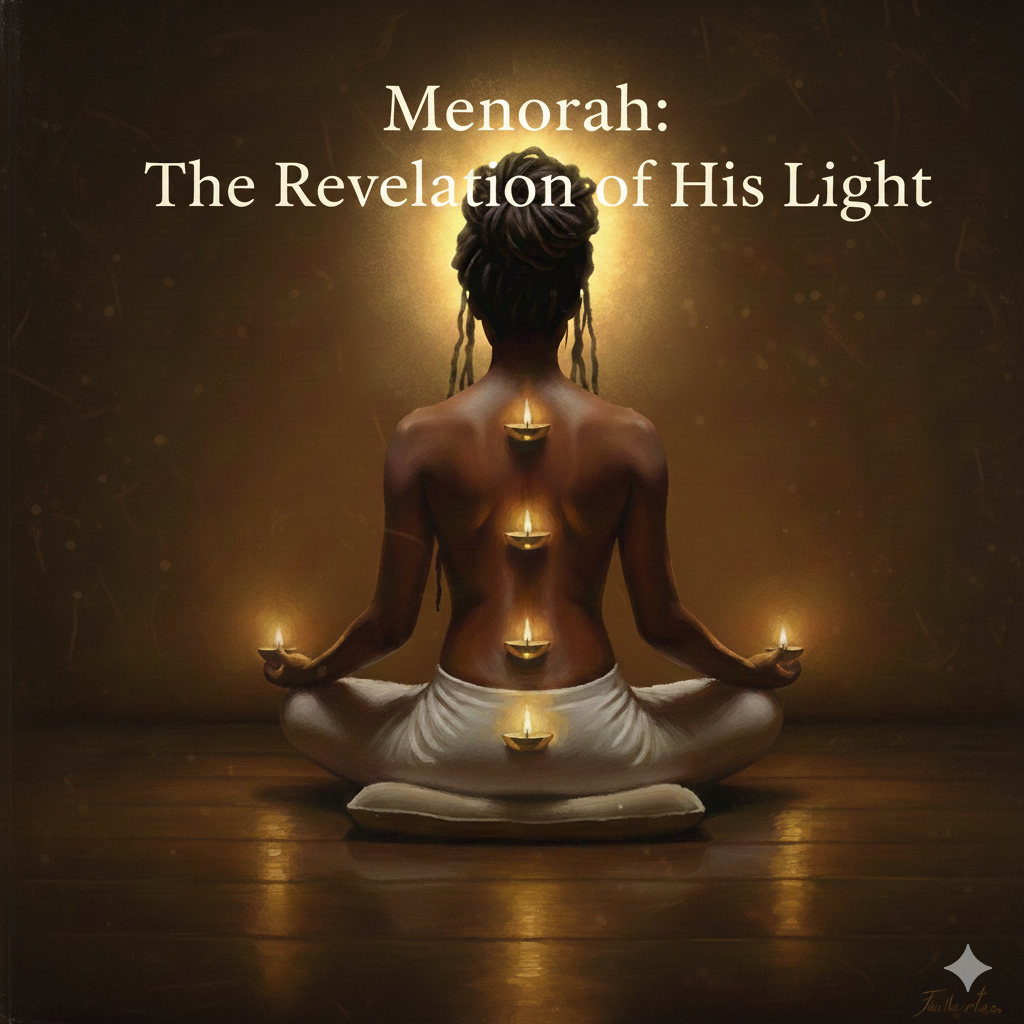
Menorah: The Revelation of His Light
In the Holy of Holies, there was no lamp, only the Presence. This meditation explores how the believer becomes God’s inner lampstand, lighting the Menorah within until illumination rises from the inside out.
When I was younger, darkness terrified me. It felt like a gruesome weight of a presence pressing in from all sides. With the lights on, everything feels lighter; shadows lost their teeth, and the world became gentle again. Those were the days of imagining monsters in corners and demons beneath the bed. Any sliver of light felt like safety.
But as I grew older, my understanding shifted. I began to train my consciousness, unlearning the illusions of childhood. I learned that the “monsters” were not real per se, and the demons held no power over a child of light. Slowly, the weight of darkness lifted. Now it was not because the room changed, but because I changed. I discovered I was a city set upon a hill, a very bright lamp that could not be hidden. I discovered that I am a bearer of divine radiance.
The irony is that the brighter my inner world became, the more I found peace in the very darkness that once tormented me. I began to love dim rooms, with little or no lights and minimal distractions, just enjoying the stillness. I could sit for hours, losing sense of time, finding a solitude that ministered to me in ways noise never could. My deepest prayers formed there, my thoughts became clearer; in here I had my truest encounters.
It was during these moments that I was drawn into a meditation on the tabernacle of Moses. This, as we know from scriptures (Exodus 25-31), is the first physical representation of the temple of God. It was delivered expressly to Moses on the mount and God commanded that it was built according to that pattern (Exodus 25:9,40. Hebrews 8:5). In that temple, the people approached God from a distance. Only the high priest entered beyond the veil, carrying sacrifices for himself and the nation. Now, beyond the veil, in that structured separation, something profound was revealed.
While the Outer Court lived in natural sunlight, and the Holy Place was lit by the golden lampstand, the Menorah, the Holy of Holies remained without any man-made source of light. Behind that thick veil, no flame burned, no lamp flickered. The only illumination came from the very Presence of God: the Glory, the Kavod. It was this divine overshadowing of the Mercy Seat that filled the room with light.
And suddenly Scripture aligned itself in me:
“The Lord shall be a light unto her, and there shall be no night there.” (Revelation 21:23-25)
The more I sat in the darkness, the more I understood why I felt so at home. I was not sitting in the dark. I was sitting in Him. I had encountered the Father of Lights, and in His presence, darkness loses definition. It does not register the same way because everything is lit from within. This led me into a meditation practice I can only describe as self-illumination; not in the mystical or self-exalting sense, but in the deeply scriptural reality that Christ in me is the Light of the world. In these moments, I sit quietly, aware of my body as a vessel of glory, beholding the word of God in Isaiah 11:2, until the candles of the Lord are lit within me.
Recall, before the priest stepped into the Holy of Holies, he first tended the lampstand in the Holy Place. In the same way, I begin by lighting the Menorah within by meditating on the sevenfold Spirit of God, recognizing in sequence the operations of the Spirit at work in me, furnished by the understanding that the spirit of man is the candle of the Lord, searching the inward parts (Proverbs 20:27). And as I behold Him in Isaiah 11:2, one light at a time- wisdom, understanding, counsel, might, knowledge, and the fear of the Lord- the consciousness begins to rise. A quiet kindling, like a warm inner brightness. An illumination that does not come from the room around me, but from the Presence within me until the space is lit from the inside out.
And this is what I long for you to discover too.
There is so much in God that we often rush past; there are treasures of revelation waiting to be explored, if only we would sit long enough to behold them. For me, it began with a simple encounter: “You are the light of the world.” I lingered over that scripture until it enlightened me from within, until I could trace its glow into every corner of my life.
What word has touched your heart recently?
Have you sat with it long enough for it to transform you? Have you allowed the Spirit to paint its reality on the canvas of your imagination, through quiet, focused meditation? Because when the seven candles are lit within you, the presence of God becomes almost tangible. It is from this inner illumination that the soul moves, gently and naturally, toward the Holy of Holies within.
And just as the High Priest carried the Urim and Thummim beneath the breastplate, close to his heart, so we too carry the revelation of righteousness as a living, awakened conscience under Christ. In that place of holy stillness, where light and truth converge, the whole counsel of God becomes available. Suddenly, you are not groping in the dark for answers; you are standing in light, equipped with divine insight for every matter presented before you.

God: “Ask Me Anything”
When God says, “Ask Me Anything,” it’s not a blank cheque, it’s more like a heart check. Access to God, to kings, or to influence is never casual. It is sacred trust, not social proof. Like Solomon, the wise ask for what aligns with Heaven’s purpose, while others like Herod’s daughter reveal the corruption of an untrained heart. Every time heaven extends the sceptre, the question beneath it is simple: What spirit are you of? Because in the end, “Ask Me Anything” does not mean “ask for anything.” It means show Me your heart.
There is a recurring pattern in Scripture that has captured my facination.
We often see scenes where kings or even God Himself estends an open invitation, “Ask me anything,” their response are rarely as lofty as the offer itself. They rarely asked for the life of their enemies, nor for half the kingdom, nor for personal comfort. Instead, they often asked for something that revealed the condition of their hearts.
Take Solomon, for instance.
When God appeared to him in a dream saying, “Ask what I shall give you” (1 Kings 3:5), Solomon didn’t rush into ambition or vengeance. He asked for wisdom — a discerning heart to govern well. His request was not self-seeking; it was aligned with divine purpose. And God, pleased with the purity of that desire, gave him more than he asked for — riches, honour, and peace in his days.
But in stark contrast, there was Salome, Herod’s daughter in Mark 6:21–28. Offered that same royal favour; “Ask me for whatever you wish, and I will give it to you, even to half my kingdom”. Prompted by her mother, she however asked for the head of John the Baptist. One request came from a heart aligned with God’s purposes; the other, from a heart corrupted by vengeance. Both had access. Only one used it righteously.
This is what I’ve been meditating on; the true meaning of access to the King. Whether it’s access to God, to authority, or to influence, the “Ask Me Anything” moment is not a test of opportunity, it’s a test of heart. When we’re granted this access, what do we ask for? What occupies the forefront of our petitions?
In our world, access is often seen as privilege: having the ear of leaders, the number of influential people in our phones, or a seat at important tables. Yet, in the Kingdom, access is not a symbol of arrival; it is a test of alignment and trust. God will never entrust “the ear of the king” to a heart still driven by lust, envy, or self-preservation. He will not hand over the key to the city to one who still burns with self-interest.
That’s why even when we pray, “Lord, give me favour before kings,” heaven’s response is often not instant access but inner refinement. God trains our hearts before He grants us influence. He purges our motives, reshapes our desires, and aligns our asking with His purpose. And even when we have access, there is a constant watch over the state of our hearts to weigh our intentions, for God is a God of Knowledge.
So maybe “Ask Me Anything” is not merely giving an open-ended license but a divine heart test, like an invitation for God to weigh our desires against His intentions. It’s as though He says, “Let Me see what you will ask for now that you have My attention.”
It is an invitation of self discovery before the throne. It is not the freedom to request anything, but the revelation of whether we understand what is truly worth asking for.
When Esther stood before King Ahasuerus, he said to her,
“What is your request? It shall be given you, even to half of the kingdom.” (Esther 5:3)
Yet, Esther did not ask for wealth or power. She asked for a banquet, for a space for purpose to unfold. Her restraint was wisdom. Her timing was faith. And through that divine restraint, an entire nation was saved.
So, when God says to you today, “Ask Me Anything,” pause before you speak.
Examine what rises in your heart first. Is it vengeance? Is it validation? Or is it vision? Maybe the point was never the question, but the heart revealed through your answer.
Because in the end, divine access isn’t about what we can get from the King; it’s about what the King can trust us with.

The Parable of the Butterfly
One quiet morning, I watched a white butterfly drift across a bed of flowers, restless and searching for a place to rest. In that gentle moment, I saw a reflection of the human soul as beautiful, transformed, yet still seeking where it truly belongs. Many of us have journeyed through our own seasons of becoming, but at the point of bloom, still wonder where purpose resides. Yet God appoints a place for His people. When we follow His leading, He guides us beside still waters and settles us where our growth can flourish. And even when we wander afar, His mercy comes searching, for He is the Shepherd who never leaves the one behind.
One day, I sat in the driveway of my aunt’s compound with her driver, waiting for her to join us as we set out for work. Usually, he would drop me off after dropping her at hers. On this particular morning, while we waited, I noticed a white butterfly fluttering restlessly through the green bushes, presumably searching for a place to bed.
As I watched, I silently rooted for it to find the only budded flower among the “yellow bush” hedge that lined the corner of the house. But as the seconds passed, I got lost in thought, kind of projecting my own state of mind onto the little creature’s struggle. Could it be, I wondered, that I have bloomed like this butterfly, yet not found a flower to rest upon? Could it be that I am in my season of beauty and maturity, but still seeking my place of purpose?
Scripture says in Romans 1:20,
“For since the creation of the world, God’s invisible qualities—His eternal power and divine nature—have been clearly seen, being understood from what has been made.”
In other words, creation is a living classroom. Through it, God speaks, reveals, and teaches us His ways. Creation is not just decoration; it is revelation. Through it, God teaches us about Himself, and often, about ourselves.Proverbs also echoes this mystery:
“I went by the field of the slothful… then I saw and considered it well; I looked upon it and received instruction.” (Proverbs 24:30–32)
That morning, as I looked upon that butterfly, I too received instruction. It struck me that this small creature had survived so many phases. It began as an egg, hidden and insignificant. It endured the slow confinement of being a larva, the silent transformation within the cocoon, and finally emerged radiant and free. It had every reason to be at peace, to rest in the beauty of what it had become. Yet at the very moment of bloom, it seemed lost: a perfect creature without a resting place.
And I thought about people, how many of us are like that butterfly? We survive the long seasons of becoming. We endure pressure, loss, stretching, and delay. We fight to grow wings. But when we finally bloom, we still feel displaced, restless, unseen. Could it be that we have focused so much on surviving that we missed the meaning of the season? Could it be that some have blossomed in the wrong gardens, existing in spaces that stifle their essence instead of releasing it? There are beautiful people living in restless motion, fluttering through jobs, relationships, and cities, yet unable to find where they truly belong. It’s not always because they are lost but sometimes, the environment simply isn’t right for what they carry. A butterfly may be perfect, but without a flower, it starves.
The more I pondered, the clearer it became that every butterfly needs a flower, but not every flower is appointed for every butterfly. In the same way, not every environment, friendship, or opportunity is assigned to your destiny. There is an appointed place for every purpose. The tragedy is not in waiting; it’s in settling too soon in a place that cannot feed your purpose.
As the butterfly flew away, I heard within me: You, too, have permission to change your position. We are not sentenced to remain where purpose cannot breathe. God gives us permission to shift; sometimes in thought, sometimes in geography, sometimes in identity. Migration is not rebellion; it is often a covenant step in destiny alignment. God is not static. He moves His people into appointed places, and in those places, He establishes them.
Scripture says, “Moreover, I will appoint a place for My people Israel, and will plant them, that they may dwell in a place of their own and move no more” (2 Samuel 7:10). That promise still stands. God doesn’t merely call us to grow; He calls us to be planted. When we follow His leading, He leads us beside still waters, makes us lie down in green pastures, and restores our souls. In the appointed place, when we go through dark shadows of valleys too deep for words to express, He is still with us and usually, that makes all the difference (Psalm 23).
So if you ever find yourself fluttering without rest, take comfort. The Gardener has not forgotten you. The flower appointed for you still exists, in the field He has chosen. And in time, you will find it, or perhaps, it will bloom right where you are, because the One who began your transformation will not abandon you mid air. He knows the field where you will find rest. And when He plants you there, you will finally understand that it was not just about flying; it was about finding home. A secure place.
And for the one who has wandered afar off, still searching for the place to land , the good news is, God is still coming for you. He is the Shepherd who leaves the ninety-nine to find the one.

Wait, while working
There’s a tension every believer must learn to live in—the waiting and the moving. The vision of tomorrow is real, yet the steps of today are unavoidable. Habakkuk says the vision is for an appointed time, but in the same breath, he positions himself on the watchtower to listen for what God will say today. Tomorrow is not meant to be chased, it is meant to be prepared for. Each act of faithfulness now is a brick laid on the road to the future. The paradox remains: the vision anchors us forward, but the present shapes us ready.
To live with vision is to see beyond the limitations of the present. A man who has no sight of tomorrow is easily swallowed by the narrowness of today. Yet, a man who only dreams of tomorrow without grounding himself in the weight of today builds castles in the air that vanish with the wind. Scripture reminds us, “Where there is no vision, the people perish” (Proverbs 29:18). But it also says, “Give us this day our daily bread” (Matthew 6:11). There is vision for tomorrow, and there is bread for today. One does not cancel out the other; both must be held in a delicate balance.
Living with the broad view allows one to endure the straitness of the now. It stretches the heart beyond the discomfort of the moment, reminding it that these light afflictions are but for a moment, working for us a far more exceeding and eternal weight of glory (2 Corinthians 4:17). Yet, living fully in the now is what gives strength to the vision. For today is not a wasted filler; it is the smallest indivisible part that makes up the whole. Every vision is built from a thousand todays, faithfully lived, consistently endured.
The prophet Habakkuk speaks with a voice that still whispers to us: “The vision is for an appointed time… though it tarry, wait for it, for it will surely come and will not delay” (Habakkuk 2:3). The vision of tomorrow has its date in God’s calendar. It will not arrive because you are restless; it will arrive because He is faithful. Yet the same God who sets tomorrow’s timing calls you to stand ready in today. He calls you to wait, to watch, and take the stance of Habakkuk; standing upon your watch. “I will stand upon my watch, and set me upon the tower, and will watch to see what He will say unto me” (Habakkuk 2:1).
The question then arises: how should a man walk in this world where every day demands urgency, but eternity demands patience? Should he run ahead into tomorrow, or settle into the quiet rhythms of today? The answer is not in choosing one and discarding the other, but in living with balance: to know the broad view, but to deliberately walk in the now, in alignment and hope towards the whole. To be rooted in today, yet stretched towards tomorrow.
But here is a warning. The vision for tomorrow can help you stay the course today, yet if you live every moment in today chasing after tomorrow, you may never truly live at all. Tomorrow was never meant to be chased; it was meant to be prepared for. Every faithful act of obedience today is a brick laid on the road that leads to tomorrow. It is the farmer who sows, waters, and tends the soil today who has the right to expect a harvest tomorrow (Galatians 6:9).
The danger of chasing tomorrow is that it blinds the eyes to the becoming of today. A man can spend his whole life staring so hard at the horizon that he forgets to take the step in front of him. Yet without steps, even the brightest vision remains unreachable. Tomorrow is not given in one sweep, it comes as a garmen woven with the thread of days, and days, and days.
Perhaps this is why the Lord tells us, “Take therefore no thought for the morrow: for the morrow shall take thought for the things of itself, sufficient for the day is its own troble” (Matthew 6:34). It is not a dismissal of vision, but an invitation into trust and obedience. For to live rightly is not to idolize tomorrow, nor despise today, but to weave both into one vision; keeping you steady with today shaping you ready.
So, for me, I choose to live in the tension. Today as seed, tomorrow as harvest. Today as faith, tomorrow as sight. Today as obedience, tomorrow as reward. This posture has built in me the capacity to endure uncertainty, has silenced the urge to complain or murmur, and has equipped me with answers when anxiety comes knocking. And as I stand in the middle of both seasons- waiting, yet still working, I cannot help but wonder:
What if the fulfilment of tomorrow’s vision is already hidden in the faithfulness of today?

The Gamble of Love
Love is never safe. It stretches us beyond our comfort, pulling us into silence that feels unbearable and risks that feel unfair. Yet, silence isn’t always rejection—it can be grief, exhaustion, or battles unseen. That’s the gamble of love: giving without guarantees, reaching without certainty. But it is also the way God loved us; risking rejection on the cross, yet still giving His all. Love may wound us, but when received, it births something eternal.
Love is not polite. It is not neat or measured. It is extreme. It pulls us to the very edges of ourselves, where patience wrestles with longing, where waiting feels like a slow unraveling, and where silence suddenly grows louder than a thousand words.
We’ve all been there.
Waiting for a reply that never came when we thought it should.
Hearing silence in a place where we longed for reassurance.
And wondering if our hope was real, or if our hearts were gambling on something one-sided.
But silence is not always what it seems.
Sometimes the silence isn’t rejection but grief.
Sometimes it’s exhaustion.
Sometimes it’s the unspoken weight of battles no one else can see.
That’s the risk of love. We never hold the whole picture. We never fully know what waits on the other side of our giving, our hoping, our reaching. We extend ourselves without guarantees. We lean in, praying to be received, but knowing full well that distance, miscommunication, or even heartbreak could meet us instead.
It feels unfair. It feels fragile. But then I remember! the greatest gamble of love was not ours.
It was God’s.
He gave His only Son for us.
He stretched His love across a cross, not with a contract that bound us to reciprocate, but with hope. Pure, reckless hope.
Hope that we would see His sacrifice. Hope that we would choose Him in return.
He risked rejection. He risked betrayal. He risked indifference.
And still… He gave everything.
That is the nature of love: a gamble.
It is not safe. It is not predictable. But it is always worth it. Because when love is received, when it breaks through the silence and lands, it births something eternal.
So maybe the ache of risk isn’t wasted. Maybe it’s a shadow of the risk God Himself took when He gave His Son for us. Love at its purest form is not safe, but it is sacred. It dares to hope in the face of rejection, it gives even when misunderstood, and it stays even when there’s a cost.
And here’s the invitation: the greatest gamble of love is already before us. On the cross, Christ risked it all, without guarantees and without forcing our hand, but simply with the hope that we would say ‘yes’. That we would receive His love, and in doing so, make His heart glad that the chance He took on us was worth it after all.
The gamble of love is this: He has already played His hand. The question now is, will you receive it?
The Paradox of Desire
We’ve all felt it—that strange moment when the thing we once prayed and longed for finally arrives, only for us to realize we’ve outgrown it. What once consumed our dreams no longer fits the person we’ve become. The truth is, our desires shift, but God’s sufficiency never does. While our longings can stretch and drive us, they were never meant to be our master. Contentment begins when we stop postponing joy to “someday” and start treasuring the provision of today. Tomorrow is not a surprise to God, and today is not a waste for us.
There’s a strange moment that happens when you finally receive what you once prayed and hoped for. At first, it feels like joy fulfilled like proof that waiting was worth it. But then, with time, you realize something else; you’ve grown past the very thing you once wanted so badly. The version of you that prayed, fasted, saved, and dreamed for it has shifted. What you chased with passion no longer fits the person you’ve become. And instead of fulfillment, a new longing rises. While this doesn’t mean the gift is worthless, it often means your soul has outpaced your old desires and that’s okay.
Still, it makes you pause and ask: are our desires truly insatiable? Are we doomed to endlessly chase after something more, something just out of reach? Or could this restlessness be less of a burden and more of a whisper, an invitation pointing us back to the only One who satisfies?
In today’s fast-paced, ever-turning world, we often find ourselves chasing what feels distant, as though tomorrow owes us clarity. We carry hope like a credit slip, living “on tab,” postponing joy until the day our desires finally arrive. Yet in doing so, we trample past the sacred currency of the present, mismatching wants with true needs, exalting what glitters and dismissing what’s been graciously given. The truth is, what we hold now is neither small nor insufficient. It is provision, measured and meaningful. And unless we awaken to this consciousness of valuing the present, we risk mismanaging the very gifts placed in our care for today. Scriptures reminds us, “Whatever your hand finds to do, do it with all your might” (Ecclesiastes 9:10). That means today matters. The task before you matter. The season you are in is not a placeholder, it is God’s stage for your growth, joy, and obedience.
The paradox of desire is this: God wired us with longings, but He never meant for our longings to be our master, neither is it up to us to fulfil every one of those desires. It is written;“He has also set eternity in the human heart” (Ecclesiastes 3:11), but with it comes the call to seek Him, as Scripture reminds us, “You will seek me and find me when you seek me with all your heart” (Jeremiah 29:13).
These desires, by God, will stretch us, and drive us to achieve great things, but they are not the measure of our worth. They point us forward, but they are not the anchor of our joy. Only God Himself is enough. As Jesus said, “Your Father knows what you need before you ask Him” (Matthew 6:8).
So what if we learned to rest here—in the now? What if instead of anxiously striving for the next thing, we trusted that God is already in tomorrow, arranging the thickets, setting the stage, preparing the provision? Maybe contentment would no longer mean settling for less but learning to feast fully on what’s in front of us.
Tomorrow is not a surprise to Him. And today is not a waste for us. It is enough.