
The Divine Clothing Principle
In Scripture, clothing is never just fabric; it is identity, authority, and covenant token. From Solomon’s servants to Christ’s seamless robe, God reveals a deeper truth: the Kingdom clothes its own. What rests upon you in the spirit shapes how you are perceived in the natural.
There is a mystery woven through Scripture (subtle, yet persistent) that the sons and daughters of God are known not merely by confession, but by appearance. Not the kind defined by fabric or fashion, but the kind that emanates from identity, consecration, and spiritual posture.
When the Queen of Sheba came to Solomon, what overwhelmed her was not first the gold, the architecture, or even the opulence of the palace. Scripture tells us she was struck by something deeper: the appearance of his servants, the apparel of his ministers, the bearing of those who stood before him. She saw something peculiar; a distinction that could not be bought, copied, or fabricated. And the record says there was no more spirit in her.
If the servants of an earthly king could carry such radiance, what then should be said of those who belong to the King of kings?
Jesus makes a profound comparison when He says that even Solomon in all his glory was not arrayed like one of the lilies of the field. Why would He say this? Because Solomon’s garments, though royal, were external. They could adorn, but they could not sustain life. They could impress, but they could not regenerate. The beauty of the lily, however, is God-imparted. It is effortless, sustained from within and renewed by divine law rather than human effort.
Because to be God’s own is to wear an appearance that heaven endorses and earth cannot fully interpret.
In Scripture, garments are never passive. They symbolize favor, authority, priesthood, restoration, righteousness, and salvation. Esther’s royal apparel gave her access before the king. Joseph’s change of garments signaled his authority in Egypt. The prodigal son was restored with a robe before his position was restored in the house. Isaiah declares that we are clothed with garments of salvation and covered with robes of righteousness. Simply put, what you are clothed with attracts what comes to you.
This is why, throughout Scripture, God often clothes a person spiritually before He elevates them naturally. Joseph received a coat before he received a throne. Priests were robed before they ministered. At the crucifixion, Jesus wore a seamless garment, woven from top to bottom; priestly in nature and unique enough that even hardened soldiers refused to tear it. That garment was not about style; it was about marking, an imprint and a visible testimony of divine origin.
There is something about belonging to God that produces a peculiar appearance that is first spiritual before it is material.
When a life is yielded to God, something shifts in the bearing of that person. There is refinement and dignity, like a halo that rests upon them from a sense of covenant standing. People may not have language for it, but they perceive it. Rooms respond to it. Opportunities gravitate toward it. Even resistance recognizes it.
When Jesus said, “You are the light of the world,” He was not speaking metaphorically alone. Light is a form of appearance. Light announces presence. It attracts, reveals and marks an individuals’ true nature. To carry God is to carry illumination that cannot hide itself. You cannot wear light and consistently attract darkness. You cannot wear glory and attract shame. You cannot wear righteousness and attract disgrace. Your clothing speaks. It summons. It reveals your kingdom.
What does this mean for you?
It means your appearance in the spirit is doing more than you think. It means God is more invested in how your spirit is clothed than your wardrobe. It also means when God clothes you, nothing can truly strip you. The blessing does not merely visit you , but like a garment, it rests upon you. You may not always feel extraordinary, but the garments of God on a yielded life are never ordinary. They are the reason doors open. The reason favor finds you. The reason certain things are drawn toward you and others are repelled.
Considering you are not merely dressed spiritually, what rests upon you in the spirit almost always finds expression in the physical. John the Baptist, clothed in camel’s hair and leather, embodied the austerity and consecration of his calling. In the same way, a regenerated believer often finds themselves drawn toward a certain manner of dress, tone, or presentation — not out of imitation, but out of alignment. There is often a natural gravitation toward colors, textures, and styles that reflect the inward posture of the spirit. Scripture itself acknowledges that attire carries meaning. There were garments specific to men and to women, the attire of a harlot, the clothes of widowhood, grave clothes, wedding garments, priestly robes, garments of skin, and fabrics set apart for sacred use. Clothing, in biblical language, was never random; it communicated identity, season, covenant, and calling.
So let’s take the time to consider: What have you been wearing in the spirit? Is your life clothed in anxiety or in alignment? In striving or in surrender? In image or in identity? When people encounter you, what rests upon you?
Let us Pray:
“Father, Clothe me in what cannot fade. Strip from me every garment not issued by You — every covering of pride, fear, comparison, or striving. Robe me in righteousness. Wrap me in humility. Let the light of Your countenance rest upon my life in a way that cannot be manufactured or imitated. Adorn my spirit as You elevate my platform. Let what rests upon me speak before I speak. And may my life reflect the glory of the One who clothes the lilies and calls me His own. Amen.”
The life of a re-generated believer is one called out of conformity unto distinction. Even in our appearance, there is a peculiar appearance that accompanies a yielded life and it cannot be curated or performed. What clothes you in the spirit will inevitably express itself in your life, choose Light.
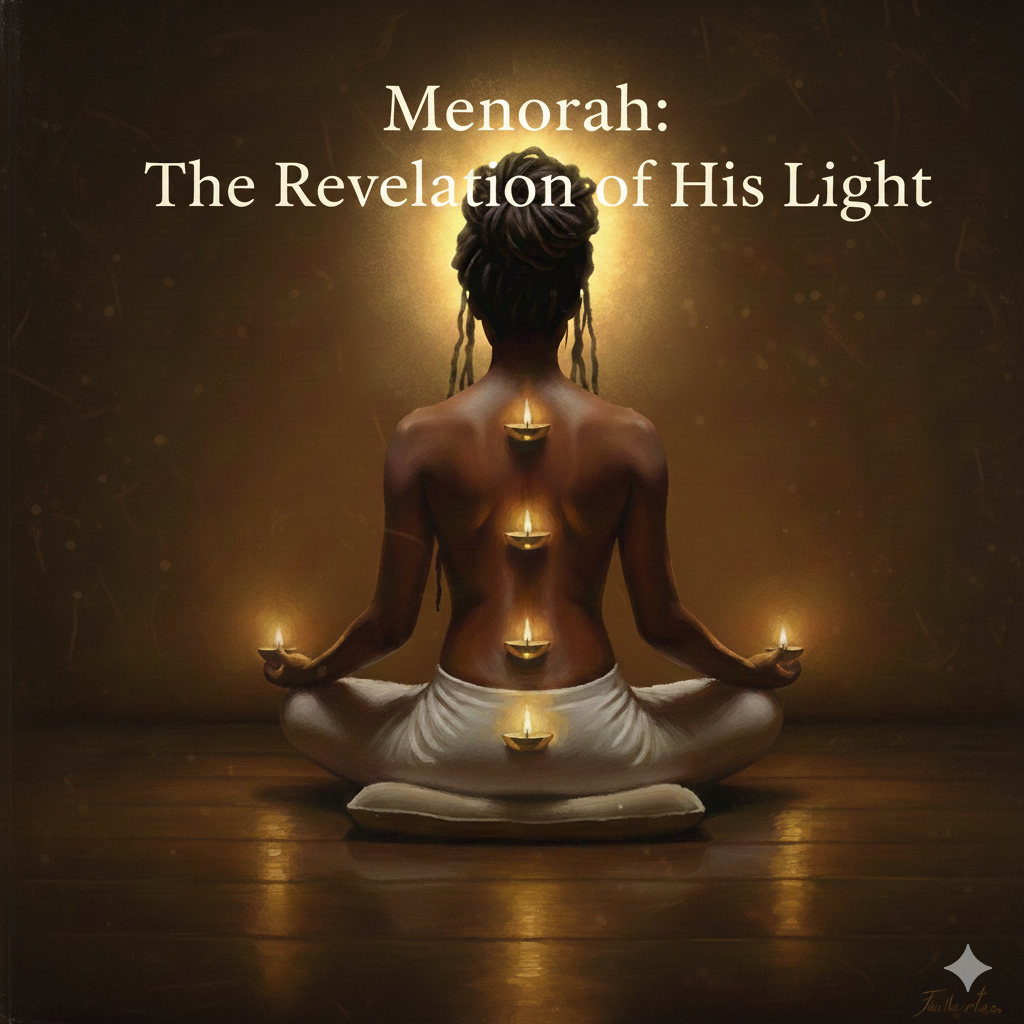
Menorah: The Revelation of His Light
In the Holy of Holies, there was no lamp, only the Presence. This meditation explores how the believer becomes God’s inner lampstand, lighting the Menorah within until illumination rises from the inside out.
When I was younger, darkness terrified me. It felt like a gruesome weight of a presence pressing in from all sides. With the lights on, everything feels lighter; shadows lost their teeth, and the world became gentle again. Those were the days of imagining monsters in corners and demons beneath the bed. Any sliver of light felt like safety.
But as I grew older, my understanding shifted. I began to train my consciousness, unlearning the illusions of childhood. I learned that the “monsters” were not real per se, and the demons held no power over a child of light. Slowly, the weight of darkness lifted. Now it was not because the room changed, but because I changed. I discovered I was a city set upon a hill, a very bright lamp that could not be hidden. I discovered that I am a bearer of divine radiance.
The irony is that the brighter my inner world became, the more I found peace in the very darkness that once tormented me. I began to love dim rooms, with little or no lights and minimal distractions, just enjoying the stillness. I could sit for hours, losing sense of time, finding a solitude that ministered to me in ways noise never could. My deepest prayers formed there, my thoughts became clearer; in here I had my truest encounters.
It was during these moments that I was drawn into a meditation on the tabernacle of Moses. This, as we know from scriptures (Exodus 25-31), is the first physical representation of the temple of God. It was delivered expressly to Moses on the mount and God commanded that it was built according to that pattern (Exodus 25:9,40. Hebrews 8:5). In that temple, the people approached God from a distance. Only the high priest entered beyond the veil, carrying sacrifices for himself and the nation. Now, beyond the veil, in that structured separation, something profound was revealed.
While the Outer Court lived in natural sunlight, and the Holy Place was lit by the golden lampstand, the Menorah, the Holy of Holies remained without any man-made source of light. Behind that thick veil, no flame burned, no lamp flickered. The only illumination came from the very Presence of God: the Glory, the Kavod. It was this divine overshadowing of the Mercy Seat that filled the room with light.
And suddenly Scripture aligned itself in me:
“The Lord shall be a light unto her, and there shall be no night there.” (Revelation 21:23-25)
The more I sat in the darkness, the more I understood why I felt so at home. I was not sitting in the dark. I was sitting in Him. I had encountered the Father of Lights, and in His presence, darkness loses definition. It does not register the same way because everything is lit from within. This led me into a meditation practice I can only describe as self-illumination; not in the mystical or self-exalting sense, but in the deeply scriptural reality that Christ in me is the Light of the world. In these moments, I sit quietly, aware of my body as a vessel of glory, beholding the word of God in Isaiah 11:2, until the candles of the Lord are lit within me.
Recall, before the priest stepped into the Holy of Holies, he first tended the lampstand in the Holy Place. In the same way, I begin by lighting the Menorah within by meditating on the sevenfold Spirit of God, recognizing in sequence the operations of the Spirit at work in me, furnished by the understanding that the spirit of man is the candle of the Lord, searching the inward parts (Proverbs 20:27). And as I behold Him in Isaiah 11:2, one light at a time- wisdom, understanding, counsel, might, knowledge, and the fear of the Lord- the consciousness begins to rise. A quiet kindling, like a warm inner brightness. An illumination that does not come from the room around me, but from the Presence within me until the space is lit from the inside out.
And this is what I long for you to discover too.
There is so much in God that we often rush past; there are treasures of revelation waiting to be explored, if only we would sit long enough to behold them. For me, it began with a simple encounter: “You are the light of the world.” I lingered over that scripture until it enlightened me from within, until I could trace its glow into every corner of my life.
What word has touched your heart recently?
Have you sat with it long enough for it to transform you? Have you allowed the Spirit to paint its reality on the canvas of your imagination, through quiet, focused meditation? Because when the seven candles are lit within you, the presence of God becomes almost tangible. It is from this inner illumination that the soul moves, gently and naturally, toward the Holy of Holies within.
And just as the High Priest carried the Urim and Thummim beneath the breastplate, close to his heart, so we too carry the revelation of righteousness as a living, awakened conscience under Christ. In that place of holy stillness, where light and truth converge, the whole counsel of God becomes available. Suddenly, you are not groping in the dark for answers; you are standing in light, equipped with divine insight for every matter presented before you.

Your Desk Is Not Too Small for God
That desk you sit at? It may not feel like a pulpit or a platform, but it is. When you offer your daily work as worship, the ordinary becomes eternal. Paul Tillich once wrote that eternity lives in every real moment. So take heart: your desk is not too small for God.
Because what seems small to man may be the altar God has chosen.
We tend to think altars must be massive, elevated, or drenched in spectacle. But sometimes, they are laminated with paper and coffee rings, nestled in cubicles, or dimly lit home offices. We often reserve the sacred for Sunday and the spectacular. But your desk - yes, your ordinary, overlooked workspace - might be the stage of something deeply spiritual.
Consecration isn’t confined to the pulpit. It is the daily offering of our time, our thoughts, and our labor unto God. And in this age of hustle, it takes courage to pause and see that the space where you respond to emails, review reports, take calls, or serve clients is not outside of God’s gaze. In the quiet hours between meetings and the moments when no one sees, we are being shaped. We are not just working; we are becoming.
Paul Tillich, in his profound work The Eternal Now, speaks about the mystery of time and presence:
“The mystery of the future and the mystery of the past are united in the mystery of the present.”
He reminds us that eternity enters time not in rare, dramatic interventions but in every real present; every moment of full presence. When we live consciously, work consciously, and honor the time we’re given, we experience kairos, i.e., divine timing; even in mundane tasks.
Work as Unto the Lord
Scripture reminds us in Colossians 3:23:
“Whatever you do, work at it with all your heart, as working for the Lord, not for human masters.”
This is not just motivational advice. It is a redefinition of workplace identity. You are not just a banker, a teacher, a designer, a customer care agent. You are a servant of God in disguise; clothed in KPIs and job descriptions, doing sacred work in secular settings.
To work consciously is to work consecratedly. It is to be awake to the divine weight of your daily labor. Even when the desk seems hidden, or the task seems menial, heaven is watching how you handle what you’ve been given.
Reimagine Your Work
Let this be your reminder:
Your desk is not too small for God.
Your schedule is not too packed for worship.
Your output is not too “corporate” to be consecrated.
If God could breathe on five loaves and two fish, He can breathe on your 9 to 5. The question is: Will you invite Him in?